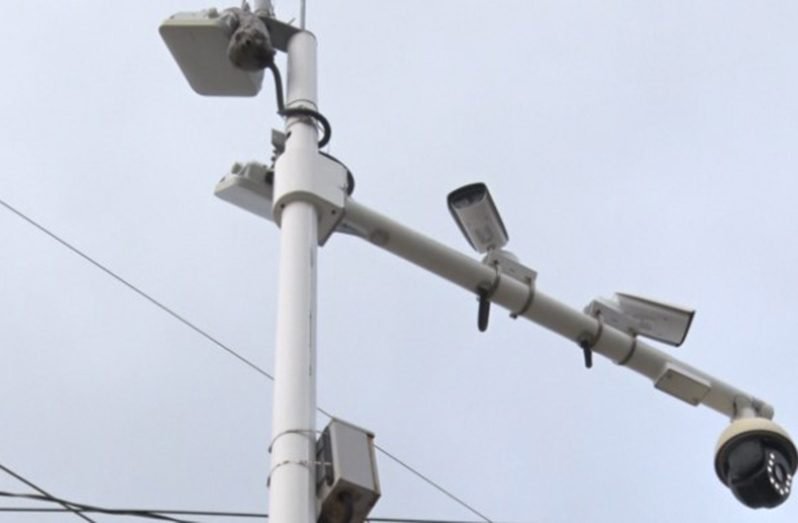
The government is moving to further expand the national surveillance network after approximately 800 CCTV cameras were deployed under the Safe Country programme over the past five years, according to Minister of Home Affairs Oneidge Walrond.
Walrond said the camera network has become an important part of the country’s shift towards technology-driven and intelligence-led policing, helping investigators identify suspects, track persons of interest and obtain evidence following criminal incidents.
Speaking on the Starting Point podcast, the minister said cameras are now operating across most regions and have already produced positive results.
The government has allocated another $5 billion in 2026 to continue expanding the Safe Country initiative.
Walrond said surveillance footage has helped reduce law enforcement’s reliance on eyewitness testimony and can provide investigators with a clearer picture of what transpired during an incident.
She also disclosed that facial-recognition technology is being used to track persons of interest and assist investigators in identifying locations where suspects may be staying.
According to the Budget, $6.2 billion was spent on the Safe Country Initiative in 2025, with 781 Intelligent Video Surveillance sites completed in priority areas across Regions Two, Three, Four, Five, Six and Ten. Another $5 billion has been earmarked for the initiative this year.
The wider Police Force has been allocated $36.2 billion this year for crime fighting and modernisation, while total security-sector expenditure is budgeted at $100.3 billion.
Walrond said the expansion is part of a broader transition away from policing that responds only after an offence occurs.
Instead, she said, authorities are increasingly using intelligence, crime mapping and surveillance to identify patterns and intervene earlier. The government has set an even more ambitious surveillance target for the next several years.
President Dr. Irfaan Ali announced in May that more than 20,000 CCTV cameras are expected to form part of a nationwide surveillance network by 2030. The proposed system is expected to incorporate cameras, drones, smart sensors and other technologies to assist with crime detection, traffic monitoring and emergency response.
Police have also been expanding regional command centres as authorities seek to establish real-time surveillance capabilities outside Georgetown.
Commissioner of Police Clifton Hicken previously said the Force intends to develop command centres across all regions as it moves from a primarily Safe City model towards nationwide Safe Country coverage.
Walrond said the existing network has already changed the way some crimes are investigated, allowing police to obtain visual evidence rather than depending solely on witnesses.
“We have seen tremendous results, positive results from the cameras,” she said during the programme. The minister said continued deployment of cameras will be accompanied by additional training for officers in intelligence-led crime fighting.