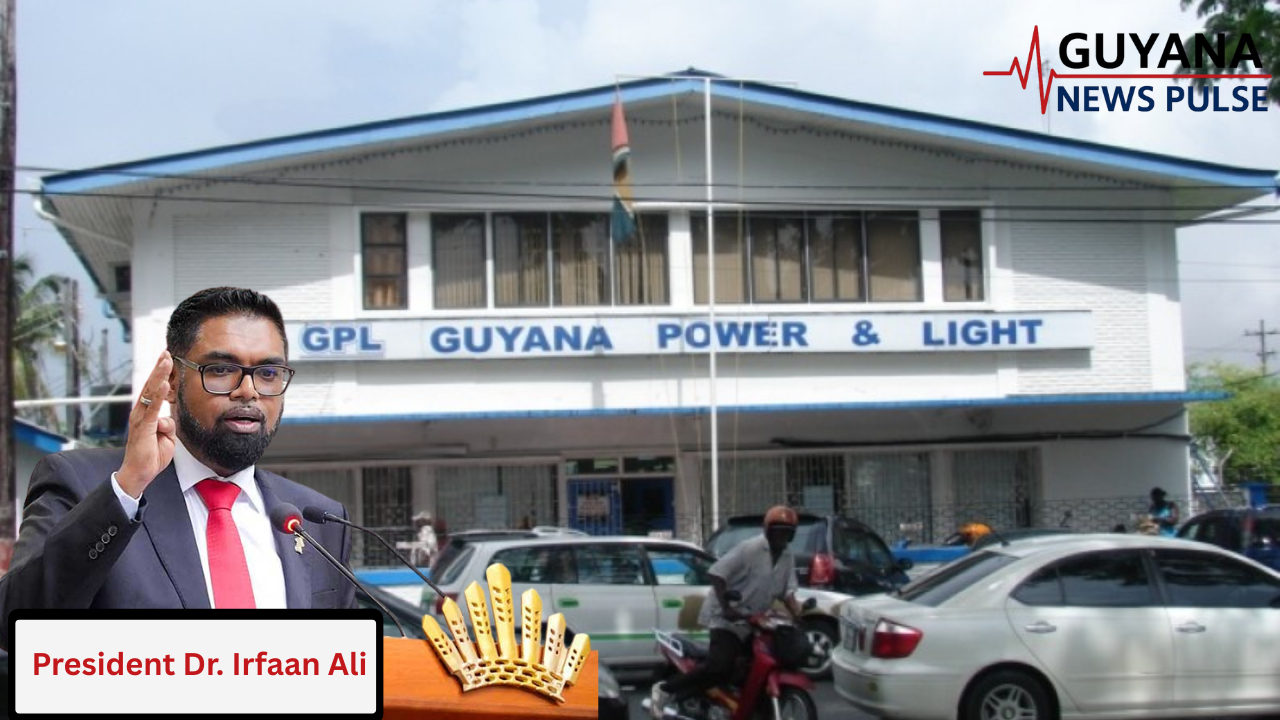
President Dr. Irfaan Ali has described the recent wave of power outages as “unacceptable,” admitting that Guyana Power and Light (GPL) is operating without any spinning reserve and that several generators are already beyond, or approaching, their scheduled maintenance periods.
Speaking at a press conference on Monday, the Head of State said the situation has left the power system with little room to absorb equipment failures or take generating units offline for routine maintenance.
“There is no spinning reserve, absolutely no spinning reserve,” the President said while responding to questions about the immediate challenges facing GPL.
He added that a number of generators have gone beyond their overhaul or maintenance periods, or are nearing them, describing the situation as “very challenging.”
The Guyanese Leader earlier acknowledged that the level of disruption being experienced by consumers cannot continue.
“We cannot continue with an unreliable system and a system that is not designed to do what the country wants it to do,” he said, arguing that major investment is now required to build a more predictable and reliable electricity network.
The President based much of his assessment on a report prepared by InterEnergy, which the Government hired to examine Guyana’s electricity system.
According to figures cited from that report, peak demand on the Demerara-Berbice Interconnected System increased from approximately 205 megawatts in 2024 to 242.6 megawatts by August 2026, an increase of about 18%.
Ali contrasted that growth with average electricity demand increases of around 3% to 4% elsewhere in Latin America and the Caribbean.
He said the rapid expansion of housing, businesses, hotels and industries is placing growing pressure on infrastructure that was not designed to accommodate demand increasing at that pace.
Ali said InterEnergy projects electricity demand could rise by approximately 138% by 2029, meaning the country could require more than twice its current level of electricity within the next several years.
GPL is also expected to add more than 62,000 customers as economic activity, housing development and industrial expansion continue.
The President said one of the immediate problems is that GPL does not have sufficient excess generation to remove units from service for maintenance without putting the wider grid under pressure.
“If anything goes wrong there, the entire system shuts down,” Ali said, while describing the lack of maintenance flexibility as a critical problem.
He nevertheless cautioned that the problem will not have a quick or inexpensive solution.
The InterEnergy report has recommended additional generating capacity, greater investment in transmission and distribution, smart metering and digitisation, and the creation of an independent grid reliability task force.
More than 360 kilometres of new high-voltage transmission lines are already being developed, along with more than 10 new substations, the expansion of four existing substations and the deployment of two mobile substations.
The wider modernisation programme also includes upgrades to the Guyana National Control Centre, advanced metering infrastructure and a 36-megawatt battery energy storage system.
Ali said technology will also have to play a greater role in detecting weaknesses before they trigger outages, including the use of drones to continuously inspect power lines for overheating equipment and failing connectors.
He argued that the traditional approach of waiting for a fault and then dispatching crews is no longer adequate for an electricity network serving a rapidly expanding economy.
“Investors require better from us. Our citizens require better from us,” Ali said. “There is no shying away from this challenge.”
The President also signalled that changes within GPL itself could be considered.
Asked about accountability for the recent disruptions, Ali said there are “some very good people in the system” but also acknowledged that “some people… don’t pull their weight.”
He said GPL needs additional technical capacity and new talent, while Government is also examining how the grid should be managed and potentially how the company itself should be structured going forward.
“We even have to look at managing a grid at a speed and efficiency and reliability that is needed. How maybe we structure the company going forward. These are very weighty conversations,” Ali said.
Ali also said the utility is facing significantly higher fuel costs. According to figures he presented, the cost of imported gas has risen by 51% since January, while diesel used for electricity generation has increased by 86.8%.
He said those increases have not been passed on to consumers because Government has increased subsidies to GPL.
While acknowledging that unexpected equipment failures can occur in any electricity system, Ali drew a distinction between occasional interruptions and the level of disruption Guyanese consumers are currently experiencing.
“We cannot promise that there will never be another interruption,” he said, before adding of the present situation: “Not what we are having now. Unacceptable.”