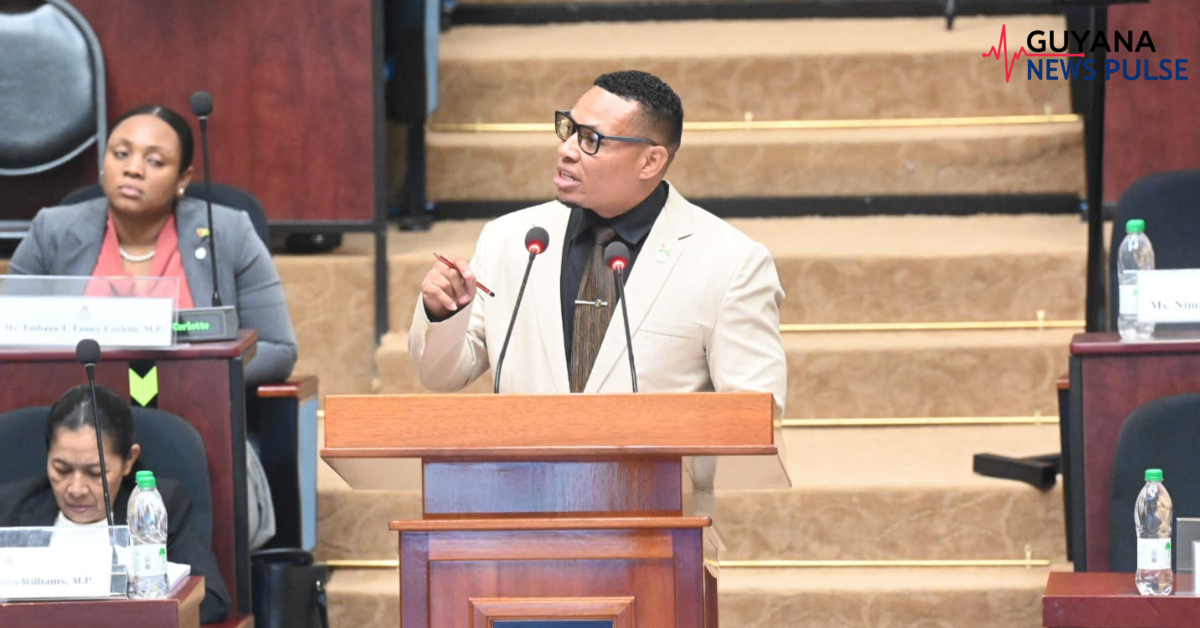
Duarte Hetsberger, a first-time Member of Parliament for the We Invest in Nationhood (WIN) movement, used his contribution to the Budget 2026 debate to argue that the trillion-dollar spending plan will fail if it does not respect Guyana’s constitutional framework for local government.
Speaking in the National Assembly after Agriculture Minister Vikash Ramkissoon, Hetsberger said his presentation was not aimed at “rhetoric,” but at testing the budget “with the supreme law of this land, the Constitution,” as well as the “budget documents and the realities of the people on the ground.”
He thanked the 109,000 voters who supported WIN at the September 1, 2025, General and Regional Elections, describing WIN as “a movement” with a purpose. While acknowledging the government’s majority in the House, he said the governing side appeared fixated on WIN’s parliamentary presence.
“If in three months…we garnered 16 seats…it’s shudder to think what will happen in five years,” he told the Assembly, characterising the government’s reactions as “insecurity.”
Hetsberger anchored his argument around local democracy, insisting that constitutional provisions for local government are being undermined in practice.
“Money cannot cure constitutional disrespect,” he declared repeatedly, warning that large allocations mean little if elected regional and local bodies are sidelined.
Citing Article 12 of the Constitution, he said local government “by freely elected representatives of the people is an integral part of the democratic organisation of the state,” and contended that real development requires empowering elected representatives and involving citizens as “partners of governance.”
He argued that centralised administration is increasingly replacing elected authority, claiming that appointed officials and “additional advisory layers” have taken precedence over councils “in practice, while leaving them accountable in name.”
“Governance is not administration and administration will never be governance,” Hetsberger said, insisting that decision-making must not be reduced to bureaucratic implementation from the centre.
A major plank of Hetsberger’s speech was the situation in Region 10 (Upper Demerara-Berbice). He claimed that months after the 2025 elections, the Regional Democratic Council had not concluded internal elections for leadership.
“It is now five months since those elections were held and yet…Region 10…has not reconvened its statutory meeting to conclude the election for its chairperson and vice-chairperson,” he said, calling it a “constitutional failure” rather than an administrative delay.
He argued that budgets and programmes are moving forward while the constitutionally mandated council is excluded from guiding, scrutinising and implementing regional development.
Hetsberger also pointed to low participation in local government elections as evidence of eroding public trust.
“The last one was 38%,” he said, contending that citizens feel their local votes matter little because “central government always manage.”
“Democracy cannot be supervised into existence,” he added. “It must be trusted…it must be practised…and it must be respected.”
Turning to Region 9 (Upper Takutu-Upper Essequibo/Rupununi), Hetsberger described the area as a vast administrative region with “more than 55 villages,” significant agricultural potential, and opportunities for tourism and cross-border trade. Development, he argued, must be sustained rather than “episodic,” and must respect local realities rather than being driven by publicity.
He raised concerns about education capacity, citing overcrowding at St Ignatius Secondary School and suggesting that Tabatinga Secondary School was intended to reduce pressure but has been behind schedule. He told the Assembly he had been informed that work at the site had restarted, while carefully noting that he was not claiming it had been abandoned.
Hetsberger also focused on roads as a lifeline to services and opportunity, arguing that poor planning and weak consultation create costly mistakes. For example, he claimed that a culvert in Baitun was built on a slope instead of at the bottom, where water accumulates, despite residents advising where it should have been placed.
Hetsberger said national spending has risen sharply since 2021 and argued citizens are entitled to see measurable improvements in quality of life. He contended, however, that local democratic organs remain constrained and that regions like Region Nine are still “waiting for delivery that matches promise.”
“A budget that expands by 300 percent…yet leaves democratic organs constrained, services uneven…reflects a failure of respect,” he said—insisting the “Putting People First” theme remains “merely a slogan” without stronger local governance and “real felt outcomes for all regions.”
He ended as he began, warning that no level of expenditure can substitute for trust, legitimacy and the authority conferred “by the ballot box.”