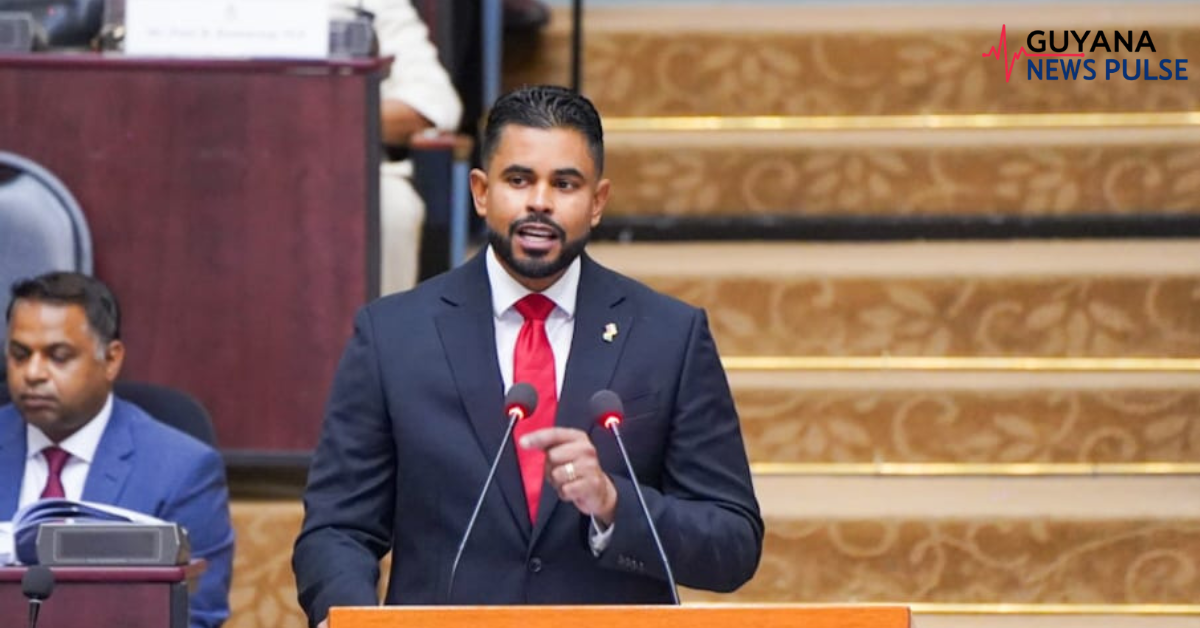
President Dr. Irfaan Ali says Budget 2026 is grounded in strong international evidence that Guyana’s economy is now more resilient, more equitable and better positioned to withstand global shocks than it was five years ago.
In a detailed assessment of the national budget and the broader economic framework, the President said Guyana’s performance on key global indices shows “clear, measurable progress” driven by successive People’s Progressive Party/Civic (PPP/C) administrations and disciplined macroeconomic management.
The Guyanese Leader pointed to the Fragile States Index, a global benchmark that measures a country’s vulnerability to instability, conflict and economic stress, noting significant improvements across several indicators since 2019.
On security, the President said Guyana has recorded one of the sharpest improvements globally, moving from a score of about 13 in 2019 to six in 2025.
He attributed the shift to sustained investments in national security, defence capabilities, modernised laws and enhanced training for security ranks.
“This decline indicates that we have improved our ability to maintain law, order and territorial control, and that our institutions are now stronger and more resilient,” Ali said.
He also highlighted progress in reducing political and economic tensions, noting that Guyana’s score on “factionalised elites” fell from about 11 in 2019 to five in 2025, signalling reduced destabilising pressures and a more inclusive economic environment.
According to the President, economic stability has also strengthened, with Guyana’s Fragile States Index score for the economy improving from 10 in 2019 to about five in 2025.
“This means the economy is more stable, better able to withstand external shocks, and is creating jobs, opportunities and wealth,” he said.
The Head of State said international data also support the government’s claim of more inclusive growth. Economic inequality, he noted, improved from a score of nine in 2019 to about 4.5 in 2025, indicating that growth is being shared more broadly across society.
“The international indicators are telling us that growth in Guyana is fairer and more equitable, benefiting all Guyanese regardless of race, ethnicity or religion,” he said.
On human flight and brain drain, the President said Guyana has made “remarkable progress,” moving from a score of 16 in 2019 to about seven in 2025.
He explained that the shift reflects fewer skilled and qualified Guyanese leaving the country, reduced capital flight, and renewed confidence among investors. “Today, that trend has reversed. There is more confidence, more investment, and more people wanting to be part of Guyana’s development,” Ali said.
Turning to the Index of Economic Freedom, the President said Guyana has made major gains in government integrity, transparency, procurement systems and judicial effectiveness.
He noted that the country’s tax burden score improved significantly, reflecting lower, more predictable and broader-based taxation that supports investment and business confidence.
“Our taxation system today is more moderate, more predictable and less dependent on human bias. It is a system that investors and citizens can trust,” Ali said, adding that government spending has become more efficient and value-driven.
Ali also contrasted Guyana’s economic growth with global and regional trends, noting that while many countries struggled to grow above three per cent, Guyana expanded by 19.3 per cent in 2025, compared with a global average of about 3.3 per cent. Growth in Latin America and the Caribbean averaged 2.4 per cent, making Guyana one of the fastest-growing economies worldwide.