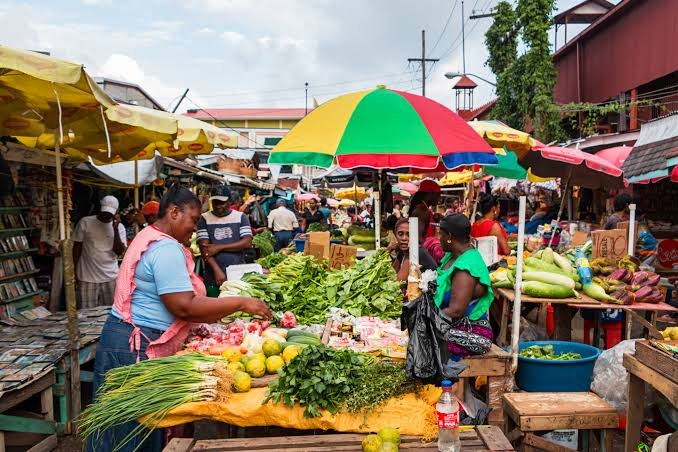
President Dr. Irfaan Ali says the government may have to look at creating permanent farmers’ markets across the country as part of a wider push to ease cost-of-living pressure and give consumers more direct access to produce.
Speaking during a press conference on Tuesday, the Guyanese Leader said the issue of cost of living cannot be solved by grants alone, but must be addressed structurally by examining what happens between farmers, retailers and consumers.

The President said while the government has already implemented several measures to reduce the cost of production, including removing VAT and other taxes, providing subsidies to farmers and reversing increases in drainage and irrigation charges and land rental fees, more must be done to address pricing along the supply chain.
The Head of State said farmers have complained that the prices they receive at the wholesale level are significantly lower than what consumers pay at retail markets.
“So the farmers, when you go to the wholesale market, the farmers are saying, look, we’re selling plantains at X dollars. But when it gets to the market, it’s 10X,” Ali said.
He said one possible solution is the creation of farmers markets across Guyana as a permanent part of the country’s buying system.
“We may need to look at the creation of farmers markets across the country as a permanent part of our buying ecosystem so that farmers have direct access to the market,” the President said.
Ali said cost-of-living pressure must be examined from several angles, including imported inflation, global price shocks, input costs, retail markups and changes in how Guyanese families shop and eat.
He noted that although Guyana produces crude oil, the country still imports refined fuel, leaving it exposed to global price movements. He said global disruptions have also affected fertiliser, agrochemicals and pharmaceutical costs, which in turn contribute to higher food prices.
The President also pointed to changing consumer habits, saying more people are shopping in supermarkets than four years ago, where profit margins differ from traditional markets. He said items such as sweet potato, cassava and plantain, once commonly bought in markets, are now being purchased in supermarkets, where higher overhead costs can affect prices.
Ali said eating patterns have also shifted, with more families eating out and cooking less at home than before. He said those cultural and behavioural changes must form part of the wider discussion on cost of living.
The President also raised concerns about what he described as “exorbitant” retail markups, saying the issue is not only about production costs but also the add-ons placed on goods before they reach consumers.
Ali said the government must address the matter in a “multi-dimensional” way, taking into account cultural issues, changing eating and buying patterns, retail margins and global pressures.
“It has to be holistic,” Ali said.