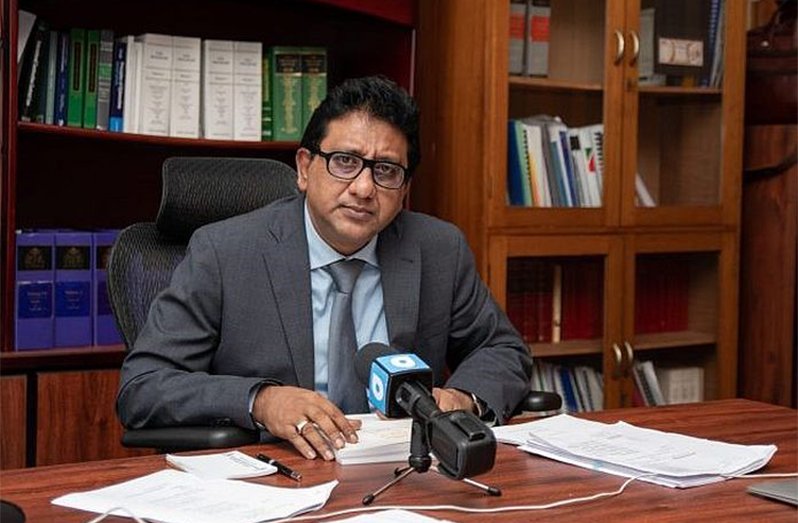
Attorney General and Minister of Legal Affairs Anil Nandlall, SC, has firmly rejected claims by US-sanctioned businessman Azruddin Mohamed that the People’s Progressive Party/Civic (PPP/C) administration had any relationship with Dutch businessman Vitesh Guptar or played a role in securing his release from custody.
Speaking on his weekly programme, ‘Issues in the News,’ Nandlall said the allegation was a deliberate attempt to mislead the public by drawing parallels between Guptar’s case and Mohamed’s own legal troubles abroad.

He maintained that Guptar has no ties to the Guyanese government.
“For the public record, Vitesh Guptar is unknown to the government, unconnected to the government and has no affiliation whatsoever with the government of Guyana,” Nandlall stated.
The Attorney General explained that Guptar’s arrest and subsequent court proceedings stemmed from an international law-enforcement process, not political influence or state intervention.
According to Nandlall, the Guyana Police Force (GPF) received an Interpol Red Notice on February 6, 2024, requesting Guptar’s detention pending an extradition request from Italy. Guptar was arrested and brought before the Georgetown Magistrates’ Court on March 19, where he was remanded until March 28 while authorities awaited formal documentation.
He said Guyana later received the “authority to proceed” along with the extradition package on April 26, 2024, in keeping with treaty obligations. The documents were presented in court on May 2, and Guptar was subsequently granted bail in the sum of $2 million.
Nandlall noted that extradition proceedings continued for several months, concluding on October 28, 2024, when the presiding magistrate ruled that the evidence was insufficient to support extradition and ordered Guptar’s release.
He further disclosed that Italian authorities later informed local officials that they were no longer pursuing extradition after Guptar agreed to cooperate with investigators in Italy on unrelated matters.
“In effect, he entered into some form of arrangement with law enforcement there,” Nandlall said, adding that the development had no connection to Guyana’s government.
Turning his attention to Mohamed’s situation, Nandlall emphasised that extradition cases are driven by requesting states and processed through legal channels, not orchestrated by the Guyanese authorities.
“The government of Guyana is not extraditing you, Mr. Mohamed. It is the government of the United States that is seeking you,” he said.
Nandlall stressed that Guyana’s role in such matters is limited to facilitating lawful requests under international agreements, and not determining guilt, innocence, or outcomes.