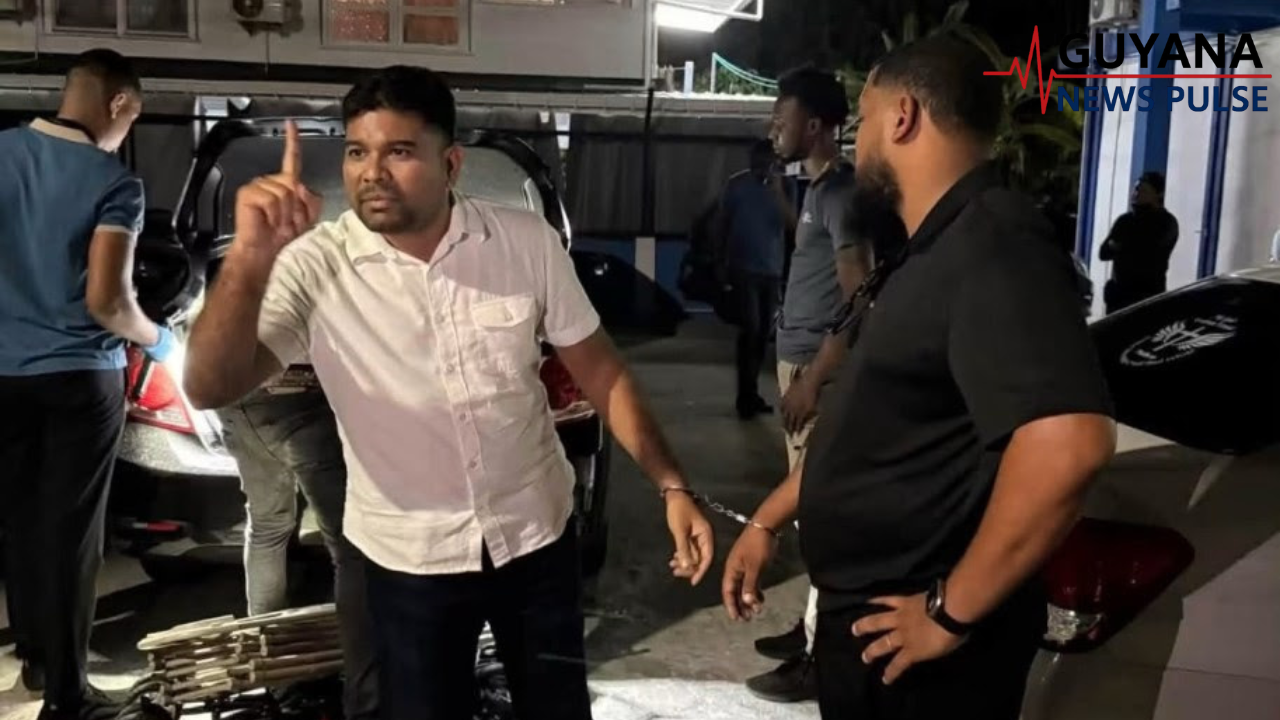
The High Court has postponed consideration of a bail application filed on behalf of Police Constable Ryan Greene after prosecutors questioned whether the proceedings were properly initiated and whether the court could exercise its jurisdiction in the manner requested.
Greene, 20, remains behind bars after being charged alongside Opposition Leader Azruddin Mohamed in connection with the alleged unauthorised release of surveillance footage from the Guyana Police Force’s Command Centre.
His application was heard before Justice Zamilla Ally-Seepaul, but arguments focused on preliminary legal issues rather than the circumstances under which the young policeman could be released.
The application was filed by Greene’s father, Randy Greene, through attorney-at-law Darren Wade, following the refusal of bail by Magistrate Abigail Gibbs on October 30.
Representing the prosecution, King’s Counsel Darshan Ramdhani argued that the defence had not established the appropriate legal basis for bringing the matter before the High Court.
He submitted that the Bail Act provides different procedures through which a magistrate’s decision may be challenged, and those requirements must be satisfied before the court can proceed.
In presenting his objections, Ramdhani referred to Section 17 of the Act, which addresses appeals to the Full Court of the High Court, and Section 20, which provides for judicial review.
He also cited Sections 18, 21 and 22, which deal with the High Court’s powers and the preservation of its constitutional jurisdiction.
According to the prosecutor, the application did not adequately identify the legal procedure being pursued, creating difficulties for the State in responding to the request.
The court also heard competing arguments over the parties named in the application.
Ramdhani objected to the inclusion of Police Prosecutor Steven Hinds, contending that the defence should have named the Director of Public Prosecutions, the Attorney General and, where appropriate, the magistrate whose decision was under challenge.
He further raised concerns that the Attorney General had not been served with the court documents.
Wade, however, defended the application, maintaining that Hinds was properly named because he had prosecuted the matter in the Magistrates’ Court on behalf of the Director of Public Prosecutions.
The attorney pointed to provisions of the Police Act that permit police officers to undertake prosecutorial duties on behalf of the DPP.
He argued that the prosecutor’s involvement in the original proceedings provided a sufficient basis for his inclusion in the High Court application.
Wade also questioned the need for the State to file a response before the preliminary legal issues could be determined.
He emphasised that the court was being asked to consider the liberty of a young man who had not been convicted of any offence.
However, Justice Ally-Seepaul indicated that the concerns surrounding jurisdiction could not be bypassed.
The judge explained that the court must first determine whether the application is properly constituted and whether the relevant parties have been correctly joined.
She further observed that merely notifying someone of proceedings does not necessarily place that person properly before the court for the purpose of responding.
The parties were consequently directed to address the jurisdictional dispute through written submissions.
Ramdhani was expected to submit his arguments on Tuesday evening, with Wade required to file his response by midday on Wednesday, November 11.
The matter could return before Justice Ally-Seepaul on Wednesday afternoon.
Until those arguments are considered, no decision has been made on Greene’s application for bail.
Greene’s defence is challenging the magistrate’s decision on several grounds, including the classification of the alleged offence under Guyana’s Bail Act.
His lawyers maintain that the offence carries a maximum penalty of five years’ imprisonment and therefore does not fall within the legislation’s definition of a serious offence, which they argue applies to offences punishable by death or imprisonment exceeding five years.
They have also disputed concerns that Greene could interfere with witnesses or compromise evidence if granted bail.
The defence has highlighted his lack of previous convictions, employment as a police officer and connections to the community as factors supporting his release.
Greene’s legal troubles stem from an investigation into the alleged unlawful extraction of police surveillance footage relating to an October 12 shooting incident outside the Kitty residence of Senior Superintendent Prem Narine.
Investigators allege that the recording was obtained from the Police Force’s Command Centre at Liliendaal and subsequently provided to Opposition Leader Mohamed in exchange for $800,000.
The prosecution has accused Greene of playing a role in obtaining and disclosing the footage without authorisation.
He was arrested on October 26 and appeared before Magistrate Gibbs at the Sparendaam Magistrates’ Court on October 30, when he and Mohamed were jointly charged under the Cybercrime Act.
Both men were denied bail and remanded to prison until November 24.
The investigation has since resulted in charges against another police officer, Constable Ashton Chappelle, who was also remanded.