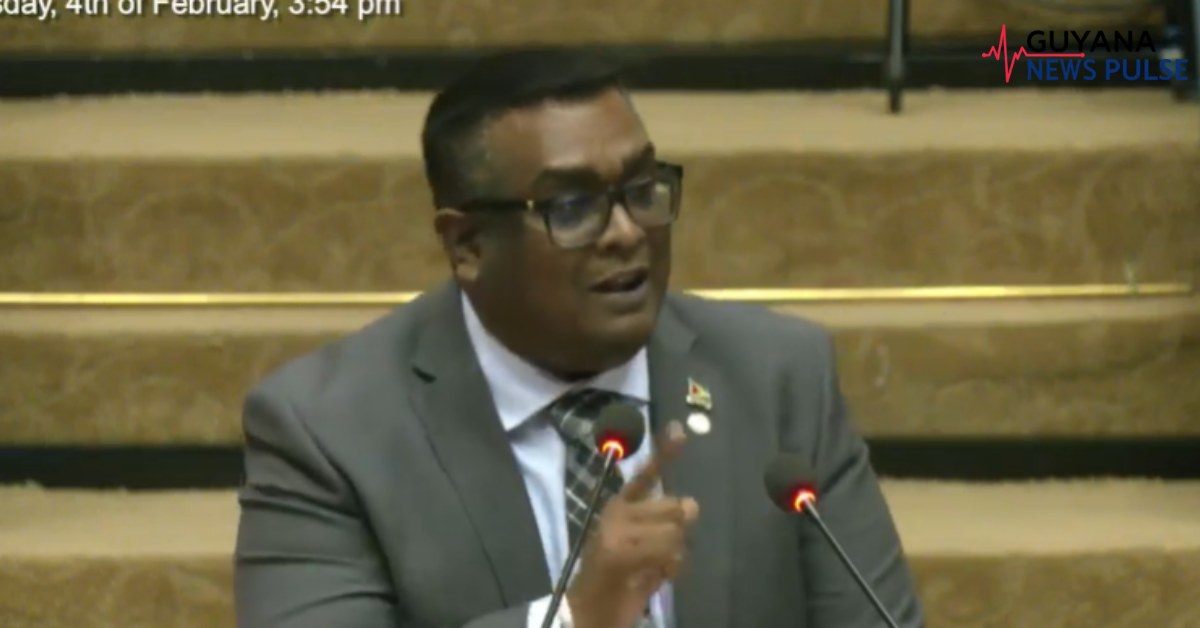
Opposition Member of Parliament Ganesh Mahipaul on Wednesday used his contribution to the 2026 Budget debate to accuse the Government of failing the country’s ordinary workers, particularly public servants, pensioners and public assistance recipients, while pouring billions into mega projects that he said benefit well-connected interests.
Mahipaul, the fourth speaker on the third day of the debates, argued that the size of the $1.558 trillion budget does not automatically make it people-centred, insisting that fairness and equity must be the real test.
“Size alone does not make a budget significant, and it certainly does not make a budget people-centred. What matters is how the money touches and improves the lives of those who wake up every morning to go to work and are forced to struggle to survive,” he told the National Assembly.
Early in his presentation, Mahipaul said public servants were left disappointed by what he described as a substance-light approach from the Minister of Public Service, Government Efficiency, and Implementation, Zulfikar Ally, who presented before him.
He called for an update to public service rules and regulations dating back to 1987, a review of the “slavish hours” of 8:00h to 16:30h, and a modernised system that supports improved service delivery.
Mahipaul also urged that public servants be given the option to work beyond age 55, moving to 60 if they choose.
“They want that as an option. They don’t want to fall off the system at 55,” he said, while claiming the current arrangement favours selected individuals through lucrative contracts rather than offering a fair, structured option across the service.
In a sharp critique of compensation, Mahipaul compared increases for senior officials to the smaller percentage raises public servants receive, arguing that the same percentage benefits high earners far more.
“So they can live as fat cats, and the people, the ordinary people who have to deliver the service, they are just simply skinny cats,” Mahipaul said, describing the situation as unfair.
He also pushed back against repeated Government references to APNU+AFC’s record, reminding the House of salary and minimum wage increases during that period, while the Speaker later required him to retract an unparliamentary term he used amid heated exchanges.
Mahipaul said the budget’s heavy focus on infrastructure and capital works, though important, becomes problematic when it is not paired with stronger direct support for the poor and vulnerable.
“This budget creates two Guyanas, one accelerating with opportunity and the other fighting for survival,” he declared.
He pointed to the daily realities of pensioners and public assistance recipients, arguing that the allocations do not keep pace with the cost of living. Mahipaul said senior citizens are being forced to work instead of enjoying retirement, and contended that public assistance levels keep recipients trapped in hardship rather than lifting them out of it.
He also called for a forensic audit of the public assistance programme, alleging that some beneficiaries may be receiving support without meeting the criteria, and urged the Government to publish clear, objective qualification standards.
Mahipaul further proposed water and electricity subsidies for eligible recipients of public assistance and pensioners, and said that homes with children with special needs should also benefit from such relief.
Turning to the Ministry of Local Government and Regional Development, Mahipaul highlighted the 2025 allocation of $41.8 billion and claimed the budget documents show $2.7 billion spent under capital works, including allocations for several market rehabilitation projects and related initiatives.
He challenged the Government to account for the spending and to demonstrate visible work on the ground.
“The Budget Book says that every cent of the $2.7 billion was spent… and so I ask… where is the work?” he asked, calling for forensic audits and warning that public funds recorded as spent but not physically verifiable raise serious accountability concerns.
He also listed multiple market projects across regions that he said were recorded as “spent out” in 2025, urging citizens and vendors to verify whether the upgrades match the stated amounts.
Mahipaul further argued that the ministry missed key performance targets, citing shortfalls in staff training, infrastructure development, and the number of entrepreneurs assisted, while spending allocations were reportedly exhausted.
Near the end of his presentation, Mahipaul said he visited markets and spoke with residents, including a vendor he identified as “Aunty Lucy,” and cited another resident’s claim that contractors are allegedly sidelined if they cannot pay bribes.
The Speaker intervened, cautioning Mahipaul about the sensitivity of the allegation and reminding him to be careful about repeating unparliamentary phrases, issuing a warning as the MP sought to conclude.
In his closing remarks, Mahipaul urged the Government to set an example in lawfulness and fairness, including the use of official vehicles, behaviour in ministries, and transparency in contracting.
“If this government truly wants the people to do the right things, then the example must first start on the government benches,” he said, adding: “The people are watching and they know when justice is not equal.”
He ended by calling for “real help and genuine action” to uplift ordinary Guyanese, insisting that a people-first budget must reduce inequality, not merely manage poverty.