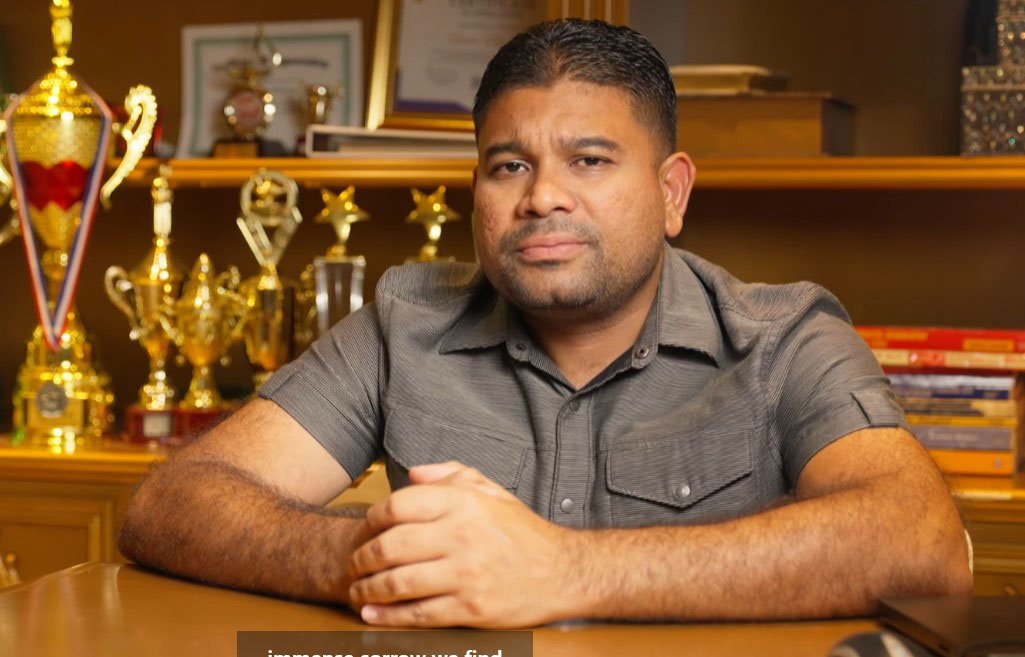
Opposition Leader Azruddin Mohamed will remain behind bars after the High Court refused to grant him interim bail on Friday, while ordering an expedited hearing of his substantive challenge to the magistrate’s decision to remand him.
Justice Priscilla Chandra-Haniff ruled that Mohamed’s request for temporary release should not be granted at this stage, instead bringing forward the judicial review hearing to November 17.
The court also struck out several disputed passages from affidavits filed in support of Mohamed’s legal challenge but allowed the substantive proceedings to continue.
The challenge was initiated by Mohamed’s mother, Bonita Mohamed, who is seeking to overturn Magistrate Abigail Gibbs’ October 30 decision to refuse her son bail on a cybercrime charge.
In explaining her decision, Justice Chandra-Haniff acknowledged the constitutional importance of personal liberty and the presumption of innocence, noting that detention before trial must not be treated as punishment.
However, the judge determined that the interests of justice would be better served by promptly hearing the substantive application rather than granting Mohamed the principal relief he is seeking before examining the lawfulness of the magistrate’s decision.

Speaking to reporters following the hearing, Attorney General and Minister of Legal Affairs Anil Nandlall, SC, welcomed the court’s decisions, maintaining that established legal procedures must be followed regardless of the individuals involved.
“The administration of justice, the rulings of court and the laws of this country cannot be turned upside down, cannot be abrogated, cannot be violated, cannot be breached, cannot be broken for the pursuit of one individual,” Nandlall said.
He explained that his objections centred on the admissibility of evidence presented in affidavits supporting the proceedings.
According to the Attorney General, several paragraphs contained material that failed to comply with the applicable rules of evidence and procedure.
He said the court upheld objections to portions of the affidavits, including passages contained in a supplemental affidavit filed by Mohamed.
“Dozens of paragraphs of irrelevant affidavits were struck out and now the case is in its proper form for us to proceed,” Nandlall stated.
He argued that the supplemental affidavit could not retrospectively correct deficiencies in material previously filed.
However, Nandlall emphasised that the court had not dismissed the entire judicial review application.
“The court did not strike out the entire application and that was not our intention,” he told reporters.
He said the removal of the disputed material would allow the respondents to address the remaining evidence when the substantive proceedings are heard.
Turning to the refusal of interim bail, Nandlall stressed that his objection was not based on an argument that the High Court could never grant temporary release before a substantive hearing.
Rather, he maintained that Mohamed’s attorneys had pursued an inappropriate legal procedure for obtaining that particular remedy.
“It is available. It is simply not available by the procedural mode and the procedural vehicle chosen by the lawyers for Mr. Mohamed,” the Attorney General said.
He argued that while constitutional proceedings could provide an avenue for seeking relief involving alleged breaches of fundamental rights, Mohamed’s legal team had chosen to pursue judicial review of the magistrate’s bail decision.
According to Nandlall, the two forms of proceedings serve different legal purposes and cannot automatically be treated as interchangeable.
He maintained that the central issue in the current proceedings is whether Magistrate Gibbs acted lawfully when she refused Mohamed bail on October 30.
The Attorney General described the attempt to obtain interim bail through the existing application as a legal error, arguing that the substantive challenge must be determined through the appropriate judicial process.
Nandlall also addressed allegations concerning the conditions of Mohamed’s detention at the Lusignan Prison.
The Attorney General argued that complaints about prison conditions, even where serious, were separate from the legal question of whether the magistrate’s original bail decision was lawful.
He pointed out that those complaints concerned circumstances arising after Mohamed had been remanded.
Nandlall maintained that allegations of unconstitutional or degrading treatment could be pursued through appropriate constitutional proceedings.
However, he argued that such claims should not be used to determine a judicial review application focused on the legality of an earlier magistrate’s decision.
Justice Chandra-Haniff similarly recognised that the allegations concerning detention conditions were serious but disputed and could not, by themselves, establish that the original refusal of bail was unlawful.
Mohamed has been in custody since October 30, when he and Police Constable Ryan Greene were remanded by Magistrate Gibbs at the Sparendaam Magistrate’s Court.
The two are jointly charged in connection with the alleged unauthorised obtaining and disclosure of surveillance footage from the Guyana Police Force’s Safe Country monitoring system.
The footage relates to an October 12 shooting incident outside the Kitty residence of Senior Superintendent Prem Narine, head of the Police Force’s Special Branch.
Prosecutors allege that the footage was unlawfully obtained and transferred to Mohamed in exchange for $800,000.
His criminal matter is scheduled to return to the Magistrate’s Court on November 24.