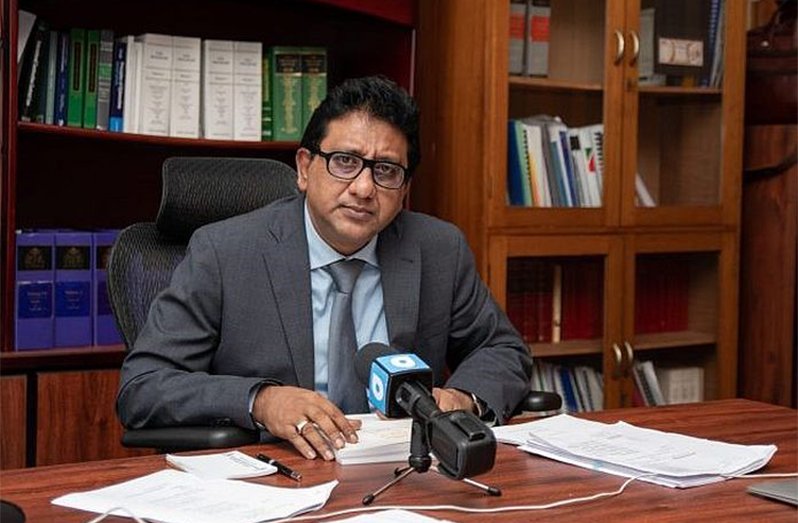
The judiciary is not immune from public criticism, Attorney General and Minister of Legal Affairs Anil Nandlall, SC, said, arguing that judicial independence does not place judges and magistrates beyond accountability.
Speaking on his “Issues in the News” programme, Nandlall defended the public’s right to question how justice is administered, including concerns about delays. However, he stressed that criticism must be made in good faith and must not become malicious attacks on judicial officers or attempts to undermine the administration of justice.
“They have the right to speak about the functioning of a public authority that they are financing. And that is why the judiciary is not immune from criticism,” he said.
Nandlall also defended his own responsibility to comment on judicial matters, saying his position as an elected representative and the minister responsible for legal affairs required him to address concerns affecting the public interest.
“A minister of justice cannot seek refuge in silence when there is a miscarriage of justice taking place,” he said.
“If the occasion arises, and I believe that I am duty bound to comment, I will comment, and if the comment is critical, then so be it.”
Nandlall maintained that an independent and competent judiciary was essential to democracy. The constitutional protections afforded to courts and judicial officers, he said, were necessary to ensure that disputes could be resolved without political pressure or other improper influence.
But those protections did not eliminate the judiciary’s responsibilities to the people it serves.
“Does judicial independence translate into judicial unaccountability? I say no,” he said.
Nandlall outlined safeguards relating to judicial appointments, security of tenure, remuneration and freedom from outside direction. He argued that these protections allowed judicial officers to carry out their duties independently, while other mechanisms, including appeals, financial scrutiny and ethical standards, provided accountability.
He also drew a distinction between the public’s access to elected officials and its relationship with judges.
While citizens could approach ministers and parliamentarians to demand answers about their responsibilities, Nandlall said direct approaches to judges about cases before them could create improper situations or the appearance of interference.
He acknowledged that insulating judges from such encounters was necessary. However, he argued that the restrictions on direct engagement made it especially important for citizens to retain legitimate avenues to voice concerns.
“However, he who seeks to criticise must do so in good faith, must not cast aspersions on the integrity of the judicial officer, must not say things that will bring the administration of justice into disrepute,” he said.
To support his position, Nandlall referred to the judiciary’s own Code of Ethics for Judicial Officers, citing the foreword to its 2021 second edition by then-Chancellor Yonette Cummings-Edwards.
He highlighted passages linking judicial integrity and accountability to the fair and transparent administration of justice, including the call: “Let us be accountable to the people we serve.”
Nandlall said those statements demonstrated that public accountability was recognised within the judiciary itself.
He also pointed to financial oversight, saying the judiciary’s expenditure of public money was subject to examination by the Auditor General. Separately, he noted that decisions by judges and magistrates could be reviewed through the appeals process.
Turning to delays, Nandlall acknowledged that most judicial officers had recently been delivering decisions in a timely manner. His concern, he said, was with exceptions where decisions took an unduly long time.
He argued that members of the public were entitled to express concern about the pace of proceedings, particularly in matters involving the public interest.
Judicial officers, he added, had a responsibility to deal conscientiously with cases, follow directions from superior courts and respect dates fixed for hearings.
Nandlall criticised the cancellation of hearing dates for what he described as flimsy reasons, particularly where lawyers had made arrangements to travel from overseas. He did not identify a particular judge or case in making those remarks.
The attorney general also cited longstanding judicial authorities to support his argument that robust criticism could coexist with respect for the courts.
Referring to the 1936 Privy Council case of Ambard against the attorney general of Trinidad and Tobago, he said the right to criticise judicial acts had long been recognised, provided it was exercised genuinely and without malice or improper allegations about those administering justice.
He also cited comments by Lord Denning recognising the right to make fair, even outspoken, observations about court proceedings, while reminding critics that judges were constrained by their office from responding.
Addressing the sub judice principle, Nandlall rejected the suggestion that the existence of ongoing proceedings automatically prevented public discussion. He argued that fair commentary on matters of public interest should be distinguished from attempts to influence the outcome of a case.
Throughout the discussion, he maintained that scrutiny should be accompanied by respect for the judiciary’s role.
“They are accountable and the public and society must hold them accountable for the discharge of their functions but must do so with dignity and respect,” he said.