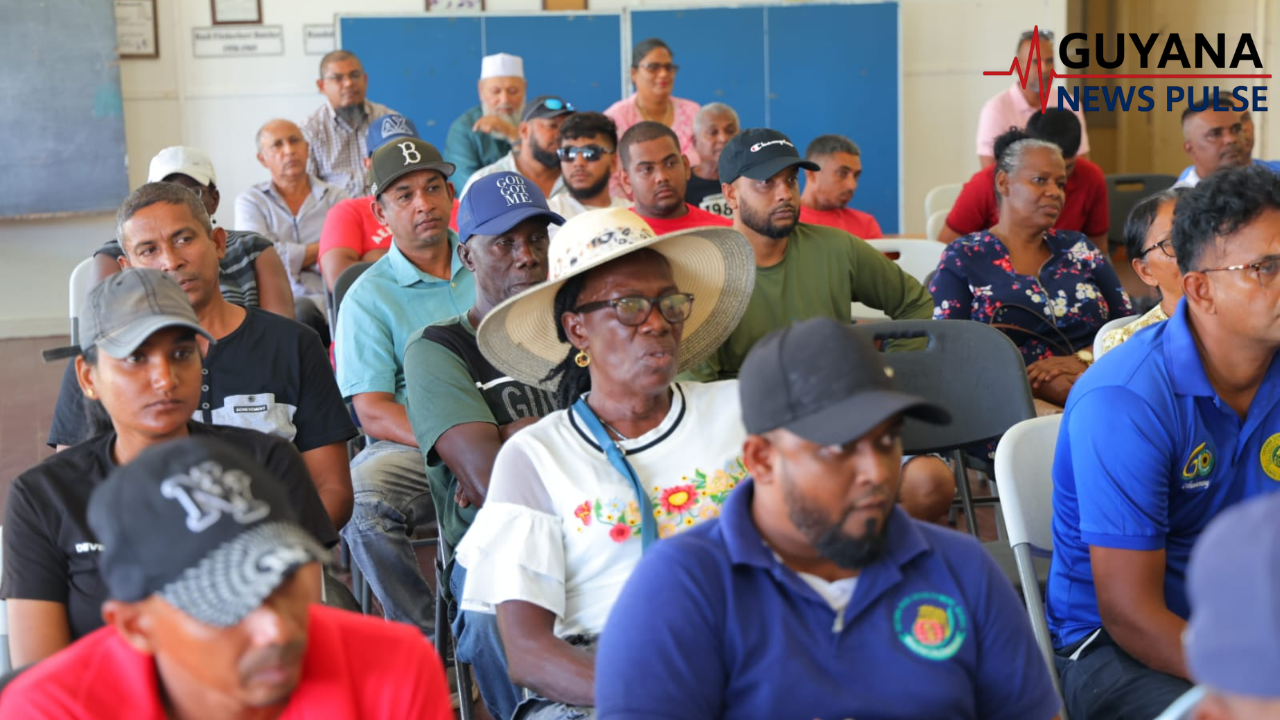
Minister of Agriculture Zulfikar Mustapha, on Wednesday, met with members of the rice cultivation verification committees from Regions Five and Six to review the findings from a series of field visits and verification exercises conducted to identify farmers eligible for the Government’s rice farmer assistance programme.
The meetings formed part of the final stage of the verification process, which was undertaken to ensure that all eligible farmers are accurately identified, and that the distribution of assistance is based on verified cultivation data following extensive field verification exercises carried out across the two regions.

According to the reports presented, a total of 2,871 rice farmers from Regions Five and Six are set to benefit from the programme.
Speaking during the engagement with the Region Five committee, Minister Mustapha said the verification exercise found that 1,387 farmers in the region are eligible for assistance.
“So, in Region Five, according to the information, 971 farmers cultivated 50 acres and below, totaling 27,427.10 acres. Above 50 acres, you have 416 farmers with a total acreage of 77,092 acres. Overall, for Region Five, some 104,519.12 acres were cultivated,” Minister Mustapha explained.
Meanwhile, during a similar engagement with members of the Region Six committee, Minister Mustapha disclosed that 1,484 farmers are set to benefit from the programme. Information presented following the verification process showed that a total of 74,314.77 acres were cultivated in the region. Of the farmers verified, 1,172 cultivated 50 acres and below, while 312 cultivated more than 50 acres.
Minister Mustapha emphasized the importance of accuracy and transparency throughout the verification process, noting that there should be no discrepancies when the programme is implemented.
“At the end of this process, there should be no issues or discrepancies. We have to ensure that this is a true reflection of what took place in the field. The Guyana Rice Development Board will now make a formal request for the funds so that distribution can commence. We have to be very careful with this programme because people will want to divide the acreage they actually cultivate in order to benefit from the higher payout,” the Minister said.
Committee members reported that during the field assessments there were instances where farmers attempted to divide their cultivation in an effort to qualify for the higher rate of assistance available to farmers cultivating 50 acres and below. However, those cases were documented and verified, with committee members indicating that sufficient evidence exists to address any claims that may arise.
Farmer representative and committee member Joseph Rooplall expressed satisfaction with the outcome of the verification process and commended the thoroughness of the exercise.

“Minister, I’m satisfied with this list. We went to the backdam on numerous occasions to verify and measure. The list came back and went back and went back until we were able to get this list that you have here now. So, this is a true reflection of what was cultivated,” Rooplall said.
It was also disclosed that in several instances, committee members recommended that extension officers revisit fields with farmers to conduct additional rounds of verification where clarification was needed, further strengthening the credibility of the process.
The assistance programme was announced by His Excellency President Dr. Irfaan Ali as part of a targeted intervention to support rice farmers across Guyana. Under the initiative, farmers cultivating 50 acres and below will receive $15,000 per acre, while farmers cultivating more than 50 acres will receive $10,000 per acre.
To ensure transparency, accountability, and stakeholder participation throughout the process, the verification committees were established with representatives from various stakeholder groups, including rice farmers, Neighbourhood Democratic Councils (NDCs), and the GRDB. The committees were tasked with conducting field visits, verifying cultivation records, and cross-checking information provided by farmers to ensure that only eligible beneficiaries are included in the programme. It also served as an additional layer of verification to complement existing GRDB records, millers’ receipts, and other supporting documentation used to determine eligibility.