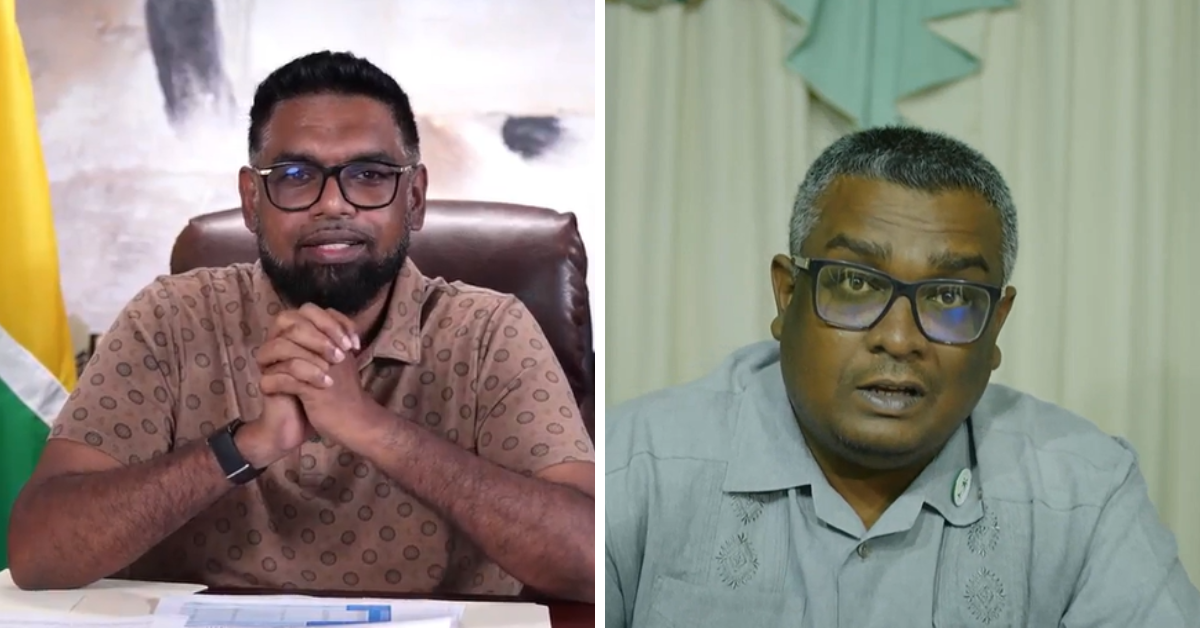
President Dr. Irfaan Ali has pushed back strongly against the APNU Coalition’s interpretation of the 2024 Auditor General’s Report, accusing them of “distorting the truth” about the state of public financial accountability under his administration.
In a Facebook livestream to the nation, the President said the report, in fact, points to “marked improvement” in transparency and the implementation of audit recommendations compared to the APNU+AFC’s term in office from 2015 to 2020.
However, at a separate APNU press conference, Opposition Member of Parliament Ganesh Mahipaul insisted the same document “exposes massive financial irregularities and mismanagement across government,” including over $1 billion in overpayments to contractors, expired drugs, missing vouchers and idle funds.
He called the pattern “deeply troubling” and symptomatic of “systemic corruption” and weak oversight.
The Head of State said the 2024 report, taken over the last four years, demonstrates “consistent improvement in accountability, transparency and good governance” under the People’s Progressive Party/Civic (PPP/C).
He argued that, contrary to claims at the APNU press briefing that the government is ignoring audit findings, the Auditor General has reported a significantly higher rate of follow-through on recommendations.
According to the President, approximately 81 per cent of recommendations made in the 2023 report were either fully or partially implemented by his administration.
“This is a marked improvement over the APNU+AFC term in office, where most of the recommendations remained unimplemented year after year,” Dr. Ali said, citing past sections of the Auditor General’s reports which expressed concern that about 83 per cent of recommendations between 2015 and 2019 had not been fully implemented.
He contrasted the two periods by noting that, between 2015 and 2019, under APNU+AFC, an average of 27 per cent of the Auditor General’s recommendations were fully implemented, 31 per cent were partially implemented, and 41 per cent were not implemented.
Between 2020 and 2024, under the PPP/C government, an average of 42.4 per cent of the recommendations were fully implemented, 37.4 per cent were partially implemented, and just 20 per cent were not implemented.
“We are working with the accounting officers to ensure that even this 20 per cent is reduced drastically in the coming year,” he said, adding that permanent secretaries and heads of agencies will soon face performance indicators tied to implementing audit recommendations and complying with financial regulations.
Dr. Ali also stressed that, unlike the period under APNU+AFC, recent Auditor General reports have not had cause to warn the current government about chronic non-implementation of recommendations.
One of the sharpest points of divergence is over how the report treats overpayments to contractors.
Mahipaul told reporters that the Auditor General examined 829 contracts valued at $48.19 billion and found that $1.011 billion was overpaid on 86 contracts administered by ministries, regions and key agencies.
He said $902 million of that sum related to 37 contracts from major central government agencies, including the Office of the President, Office of the Prime Minister, the Ministries of Foreign Affairs, Local Government, Amerindian Affairs, Agriculture, Public Works, Human Services, Education, Health and Home Affairs, and the Guyana Police Force and Guyana Defence Force.
An additional $109.99 million in overpayments occurred across nine Regional Democratic Councils, he added.
Describing this as “mismanagement and wastage of billions of taxpayers’ dollars,” Mahipaul argued that because these figures emerged from sample audits, “the true extent of financial irregularities could be far greater.”
But President Ali insisted that, judged properly, the same data paints a different picture.
He noted that the overpayments represented less than 3 per cent of the contracts reviewed in 2023 and 2024, even as overall government spending has grown.
More importantly, he said, for three consecutive years: 2022, 2023 and 2024, 100 per cent of overpayments detected during audits were recovered before the Auditor General’s report was finalised, something he described as “unprecedented.”
He contrasted this with figures from the APNU+AFC years, stating that more than 70 per cent of overpayments in 2015, 2017 and 2018 were never recovered, with the recovery rates standing at 7.49 per cent in 2015, 29.7 per cent in 2017 and 12.1 per cent in 2018.
“This is the fact. This is what is in the Auditor General’s report,” Dr. Ali said. “The narrative, the lies, the misinformation and disinformation pursued by some in the opposition is totally not within the facts and realities.”
He attributed the improved performance partly to training public officers in contract management, procurement and valuation of works, and said the government will now roll out technology for real-time project accounting and auditing using digital tools, artificial intelligence and predictive indicators.
“We are going to move to a system whereby we will have real-time audits of projects, project financing and disbursement,” the President said, so that overpayments can be detected and adjusted even during the life of a project.
Mahipaul, however, argued that the volume and nature of the issues flagged in the report cannot be dismissed as teething problems in a growing economy.
He claimed the report “paints a deeply troubling picture of financial recklessness, weak oversight and persistent breaches of accountability laws within several ministries, departments and regional administrations.”
Beyond recommendations and overpayments, President Ali pointed to a series of other indicators which he said demonstrate “marked improvement” in public financial management between 2020 and 2024.
On audit opinions and coverage, Dr. Ali said that during the 2024 fiscal year, more than 254 audit opinions were issued for public enterprises, statutory bodies, trade unions, Neighbourhood Democratic Councils (NDCs), foreign-funded projects and constitutional agencies.
He described this as the third-highest number since 2015. In comparison, he noted, there were 116 opinions in 2015 and 96 in 2016, arguing that the jump shows more agencies are being audited and are “coming into real time,” with their accounts brought up to date.
He added that 34 audits of foreign-funded projects in 2024 all resulted in unqualified opinions, indicating no material irregularities.
On breaches of the Procurement Act, the President said the Auditor General reported a “marked reduction” in procurement breaches, and that the number of recommendations relating to procurement in 2023 was lower than the previous year and lower than any of the five years APNU+AFC was in office.
He credited this to efforts by the Ministry of Finance, including a series of circulars reminding agencies of their obligations under the Procurement Act and associated regulations.
With respect to the Financial Management and Accountability Act (FMAA), Dr. Ali said there was “overall improvement in compliance” with the FMAA and circularised instructions, as evidenced by a reduction in recommendations on these issues. This, he suggested, points to better adherence to financial rules by budget agencies.