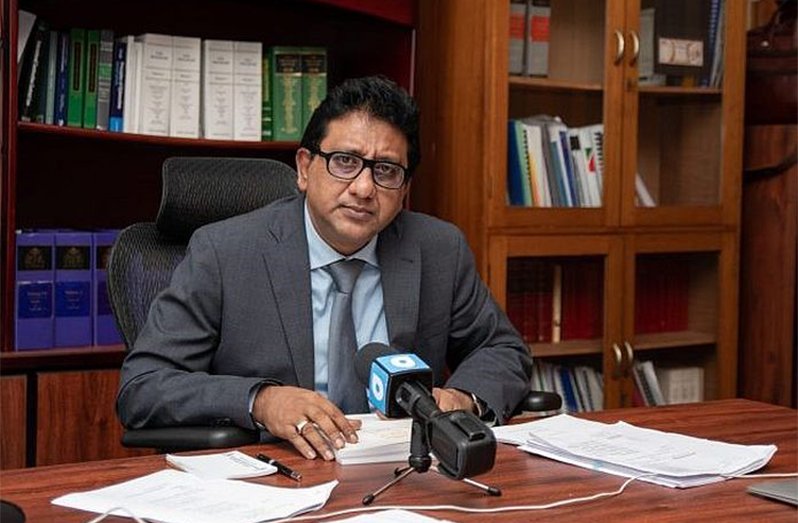
Attorney General and Minister of Legal Affairs Anil Nandlall, SC, says Guyana is heading into a major legislative reset in 2026, with a package of reforms aimed at modernising how evidence is treated in court, strengthening corporate regulation, filling a long-standing gap in trust law, and upgrading cybercrime legislation to meet international standards.
Speaking on his weekly programme “Issues in the News,” Nandlall said the centrepiece will be a long-overdue replacement of Guyana’s Evidence Act, which he described as badly out of step with modern reality.
“The current Evidence Act of Guyana is the 1893 Evidence Act of the United Kingdom,” he said, arguing that a modern system must reflect an era of digitisation, electronic records, and new ways information is stored and processed.
“We are now living in an ICT world, and a modern Evidence Act must embrace this new reality,” Nandlall told viewers. The draft bill is already being prepared using an established international template.
“We are using the Australian model. The bill is in draft, and it will be considered by Cabinet and then taken for discussion in the public domain,” he said, noting that several Caribbean states have already enacted similar reforms.
Alongside the Evidence Act, the Attorney General said the government is preparing updates to the Companies Act, signalling that the 1995 law, while strong, now needs revisions to reflect changes in finance and commerce over the past three decades.
“Our Companies Act is now 30 years old,” he said. “The financial world has transformed, and we need to update our legislation.”
He added that consultations have already started with the legal profession, accounting bodies and the private sector, with further engagement expected before the proposals move to Cabinet.
Nandlall also said the government intends to introduce a Trust Bill/Trust law in 2026, emphasising that Guyana has no legislation governing trusts, despite their wide use in personal arrangements and complex commercial transactions.
“In Guyana, we don’t have a Trust Act,” he said, describing trust law as essential as the economy expands and the financial sector becomes more sophisticated.
He also pointed to international compliance pressure, saying the Financial Action Task Force (FATF) has identified the absence of a trust law as a “critical deficiency” that Guyana must address early.
The Attorney General said the government is also moving to update Guyana’s cybercrime framework in 2026, with plans to adopt a United Nations-backed model approach.
“During the year 2026, we will be adopting that model,” he said, referencing a UN model of cyber legislation endorsed by a large number of countries, and arguing the upgrade is necessary as technology use expands across government and society.
While focusing on legislation, Nandlall also flagged reforms he said are needed to strengthen accountability in the wider justice system, including amendments to the Legal Practitioners Act to improve discipline and standards within the profession.
“The Legal Practitioners Act has to be amended. We have to have a stronger regime of discipline for errant practitioners,” he said, adding that he plans to engage the Guyana Bar Association early in 2026 to begin discussions.