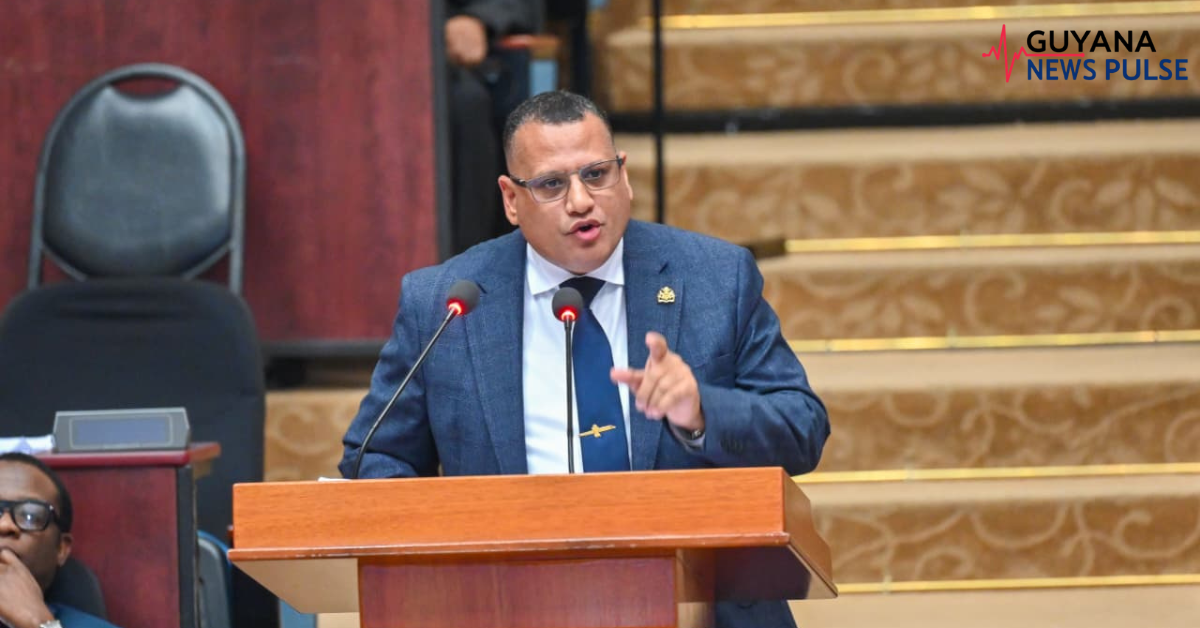
Minister of Housing Collin Croal on Wednesday told the National Assembly that the Government will move “aggressively” in 2026 to reduce the housing backlog, expand and upgrade schemes across the country, and roll out thousands of new homes.
Croal, the 13th speaker in the Budget 2026 debates, said housing remains a national priority under the $1.558 trillion spending plan, arguing that the programme is aimed at ordinary Guyanese who want “a key, a title, a home, a future.”
“Housing is not done in abstract. Housing is deeply personal… All they want is a key, a title, a home, a future,” Croal said, as he commended Budget 2026 and insisted it is “not a budget for the privileged few.”
Croal outlined a slate of commitments for the next phase of the housing programme, including plans to construct 8,000 homes in the coming period, covering low-, moderate-, and other-income categories, including young professionals.

He said the ministry also intends to issue at least 7,000 titles and transports, build or expand recreational facilities and green spaces, assist with street lighting, and develop designated truck parks and “auto zones” in areas where communities have raised concerns about heavy-duty vehicles.
Among the locations he listed for new and upgraded housing were Regions One, Two, Three, Four, Five, Six, Seven, and 10.
Addressing allegations of unfairness and “favouritism,” Croal said housing allocations are not based on political support and challenged Opposition MPs to provide an example of a case brought to the ministry that was not addressed.
He also disclosed figures for pending applicants, particularly in Region Four, saying that Region Four has 52,142 pending applicants, which he linked to population size and a historical backlog.
He said the Government remains committed to clearing arrears across regions, listing targets including Region 1 (187), Region 2 (2,000), Region 3 (10,000), Region 5 (3,500), Region 6 (8,000), Region 7 (300), Region 8 (70), Region 9 (900), and Region 10 (3,000), while continuing work to reduce the Region Four backlog.
He said the ministry will also press ahead with major road and highway works tied to housing expansion, including completing the Craig to Land of Canaan Highway, beginning the Schoonord to Parika Highway, completing overlays from Eccles to Great Diamond and Meer-Zorg to Crane, and completing additional lanes from Eccles to “Massy Road” on the Heroes Highway corridor.
Croal also sought to address criticism about road construction costs, saying comparisons often ignore added scope such as access roads, roundabouts, lane widening, drainage works, utility relocation, signage, lighting, bridges and culverts, adding that these are “open tender” works.
The Housing Minister said that over the past five years, the Government allocated 53,000 house lots, exceeding its manifesto target of 50,000. He reported that more than 100 housing areas were established and that more than 22,000 allocations were made to single women. Croal added that 86% of allocations, about 45,000, went to low- and middle-income allottees.
He further said the ministry regularised 1,912 informal settlers, processed 25,000 land titles, and constructed 4,500 houses, including 235 core homes. Croal also pointed to a community-based blockmaking initiative, stating that 28,710 concrete blocks were sold and 116 block makers were employed, including women and persons living with disabilities.
He defended the steel-and-cement subsidy programme, saying it supports households from the foundation level and has brought relief to over 10,000 households.
Croal provided updated figures on Silica City, describing it as a large-scale development covering over 3,000 acres. He said the Government has committed $5.2 billion to Phases One and Two and claimed that about $2.3 billion has been spent to date.

According to Croal, the Government spent $1.2 billion to complete Phase One of the infrastructure, which supports the construction of 110 houses, with 40 completed so far. He said an additional $800 million was invested in completing houses, and about $348 million was paid as a mobilisation advance for Phase Two infrastructure.
Croal said the Government recently launched the Yarrowkabra Homestead Programme, aimed at affordable and sustainable home ownership for low- and middle-income female-headed households, noting that applicants have already begun pre-qualifying.
He also highlighted adjustments to housing finance, noting that the low-income mortgage ceiling at commercial banks has increased from $20 million to $30 million, and that insurance companies are now included to offer similar services. Croal said the “single window approval system” is also being pursued to speed up approvals, while urging local democratic organs to play their part in timely processing.
As he concluded, he said his support for Budget 2026 was based not on the headline number, but “the lives it will transform,” and pledged that the housing drive will continue to expand over the next five years.