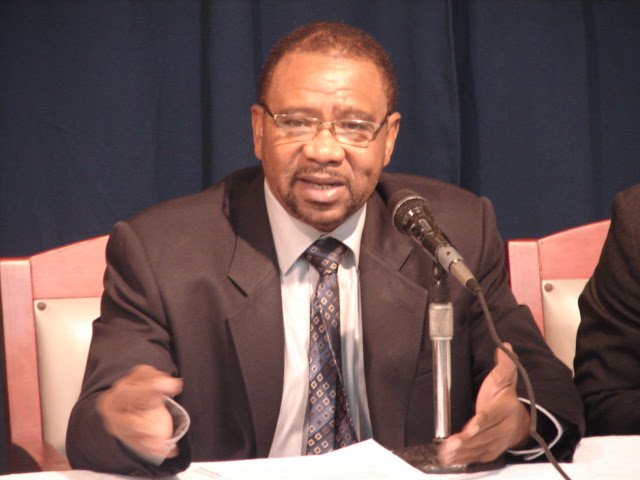
Leader of the People’s National Congress Reform (PNCR), Aubrey Norton, is against Budget 2026, arguing that the spending plan “does not put people first” and warns it will deepen hardship for workers, pensioners and vulnerable households.
During the party’s press conference on Friday, Norton contended that the governing People’s Progressive Party/Civic (PPP/C) adopted the “Putting People First” theme despite, he said, producing a budget that prioritises contracts and infrastructure over direct household relief.
“The 2026 Budget is a recipe for increased poverty and does not put people first,” he declared.
Norton said the opposition finds it “interesting” that the government used a theme associated with his coalition, arguing that a budget truly designed around people-first development would have included stronger measures to address cost-of-living pressures, poverty, a “livable income,” and a more robust anti-corruption programme.
He claimed the $1.558 trillion budget places heavy emphasis on infrastructure, stating that 50.04 per cent is allocated to infrastructure development. While acknowledging the importance of roads and other projects, Norton argued it should not come “at the expense of the development of the people.”
A major plank of Norton’s statement was the assertion that large-scale infrastructure spending creates fertile ground for waste and corruption. He argued that “30% or more” of infrastructure allocations can end up in corruption and wastage, and pointed to a comparison between Guyana and Trinidad and Tobago to support the claim.

He referenced the Ogle-to-Eccles bypass project and compared it with the Churchill Roosevelt Highway Extension to Manzanilla, asserting that Guyana’s project cost about US$17.15 million per kilometre, compared with about US$11.94 million per kilometre in Trinidad and Tobago, a difference of roughly US$5.21 million per kilometre, according to the figures he cited. Norton said the comparison was “unmistakable evidence of incompetence, corruption and wastage.”
He also argued that, despite President Dr. Irfaan Ali’s public commitments to confront corruption, Budget 2026 contains no meaningful measures to tackle what he described as incompetence, wastage, and widespread corruption.
On wages, Norton said the government’s 9 per cent increase for public servants is inadequate and called for a minimum 25 per cent wages and salary increase. He also criticised the level of cash transfers and social support, arguing they do not match the reality of rising living costs.
He said the “Because We Care” grant increased by only $10,000 and contrasted this with a proposal advanced by A Partnership for National Unity (APNU) during the last election campaign. Norton also criticised the old-age pension adjustment, noting it had risen by $5,000 to $46,000 per month, and argued that the government should honour a $60,000 commitment he said had been previously promised.
Public assistance, he said, rose by $3,000 to $25,000 per month, an increase he labelled “a pittance”, while Pathway workers would receive $50,000 monthly, which he described as insufficient given their circumstances.
Norton took aim at allocations for the Men on Mission, saying the programme was budgeted to receive $900 million, nine times, he claimed, the $100 million set aside under the Ministry of Finance for community development programmes aimed at improving living conditions for vulnerable groups across all ten regions.
He called for “an immediate forensic audit” of Men on Mission allocations, arguing the programme risks becoming a “slush fund for corruption and wastage.”
Norton maintained that direct people-focused measures account for too small a share of the overall budget, claiming that key measures he listed total about $78 billion, roughly 5 per cent of the $1.558 trillion plan.
He also argued that “putting people first” appears only once in the budget documents, while “infrastructure” is referenced more than 30 times, an imbalance he said reveals the government’s real priorities.
He urged Guyanese to look beyond slogans and examine the spending details. “APNU calls on Guyanese to scrutinise not the slogans, but the numbers,” he said, arguing that Budget 2026 “puts contracts first for the governing elite… not the poor and vulnerable citizens.”
Budget 2026 was presented under the theme “Putting People First,” and debate is expected on Monday, February 02, 2026.