
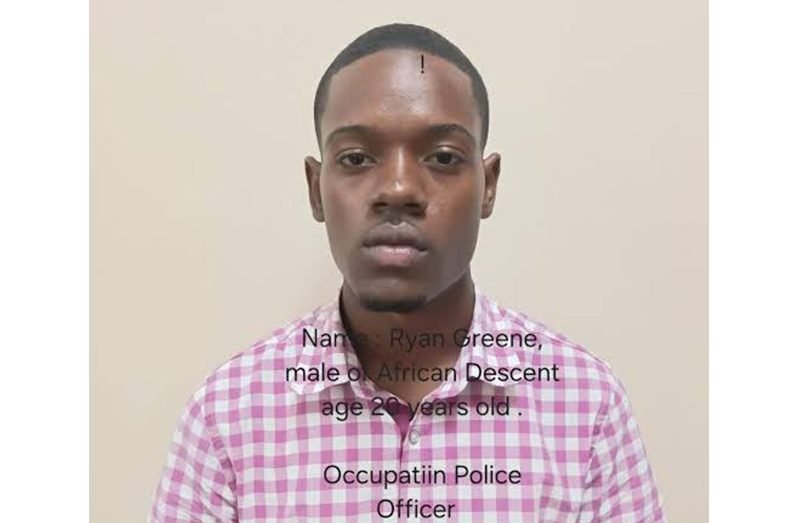
Police Constable Ryan Greene, who is accused of receiving $800,000 for allegedly supplying surveillance footage to Opposition Leader Azruddin Mohamed, has moved to the High Court seeking his release from prison, with his attorneys arguing that the charge against him does not meet the legal definition of a serious offence under Guyana’s Bail Act.
The 20-year-old policeman, who was remanded on October 30 alongside Mohamed, is challenging Magistrate Abigail Gibbs’ decision to refuse him bail in connection with the alleged unauthorised disclosure of footage from the Guyana Police Force’s Command Centre.
The latest application was filed on Greene’s behalf by his father, Randy Greene, through Attorney-at-Law Darren Wade, who is contending that the Magistrate erred in her assessment of the charge and the grounds advanced by prosecutors for keeping his son in custody.
According to the application, the defence maintains that the penalties prescribed under the Cybercrime Act do not satisfy the threshold for classifying the alleged offence as serious under the Bail Act.
The elder Greene argues that the legislation defines a serious offence as one punishable by death or a term of imprisonment exceeding five years.
However, the Cybercrime Act provision under which his son was charged carries a maximum prison sentence of three years on summary conviction and five years on conviction on indictment.
On that basis, the defence contends that the Magistrate’s characterisation of the offence as serious was legally incorrect.
The application also takes issue with the prosecution’s contention that Greene could interfere with the ongoing investigation if released on bail.
His father maintains that investigators failed to present sufficient evidence demonstrating that the constable posed a genuine risk to witnesses or the integrity of the investigation.
The defence argues that the mere continuation of a police investigation cannot automatically justify depriving an accused person of bail.
It contends that prosecutors did not identify any particular witness Greene was likely to approach or any evidence he was suspected of being capable of interfering with if released.
The application further challenges the absence of specific supporting material linking the constable to any alleged attempt to obstruct the investigative process.
These arguments directly contest the position taken by prosecutors during the October 30 hearing, when the state urged the Magistrate to refuse bail because of concerns about possible interference and further criminal conduct.
The Magistrate ultimately sided with the prosecution and ordered Greene and Mohamed remanded until November 24.
Another central issue raised in Greene’s High Court application concerns the nature of the surveillance footage and whether its alleged disclosure constituted an unlawful act.
His father disputes the prosecution’s classification of the recordings as national security information, maintaining that the footage captured events along a public roadway and contained information relevant to an ongoing criminal matter.
The recordings relate to an October 12 shooting incident outside the Barr Street, Kitty, residence of Senior Superintendent of Police Prem Narine, who heads the Guyana Police Force’s Special Branch Unit.
Narine is also a witness in the ongoing extradition proceedings involving Mohamed and his father, businessman Nazar Mohamed.
Following that incident, the Opposition Leader and two associates faced charges involving the alleged unlawful possession of a firearm and ammunition and an attempt to obstruct the course of justice.
Mohamed subsequently presented surveillance footage during a press conference, disputing aspects of the police account of what transpired outside Narine’s residence.
Greene’s application argues that the recordings were relevant to Mohamed’s ability to defend himself against those allegations and raised matters of public interest concerning the conduct of law enforcement officers.
The defence further relies on constitutional protections relating to freedom of expression and the communication of information.
It maintains that even if Greene were found to have supplied the footage, which the application does not admit, the disclosure could be legally justified because of its relevance to the criminal proceedings.
The argument remains contested, with prosecutors maintaining that the recordings originated from a protected police surveillance system and were obtained and transferred without authorisation.
According to investigators, Greene was attached to the Police Command Centre when he allegedly accessed and downloaded recordings of the October 12 incident.
Police allege that the footage was subsequently transferred to Mohamed in exchange for $800,000.
Greene was arrested on October 26, while Mohamed was taken into custody two days later.
Both men appeared before Magistrate Gibbs at the Sparendaam Magistrates’ Court on October 30, where they were jointly charged under the Cybercrime Act.
The prosecution argued that the circumstances surrounding the alleged transaction warranted continued detention, while defence attorneys challenged the legal basis for refusing bail.


