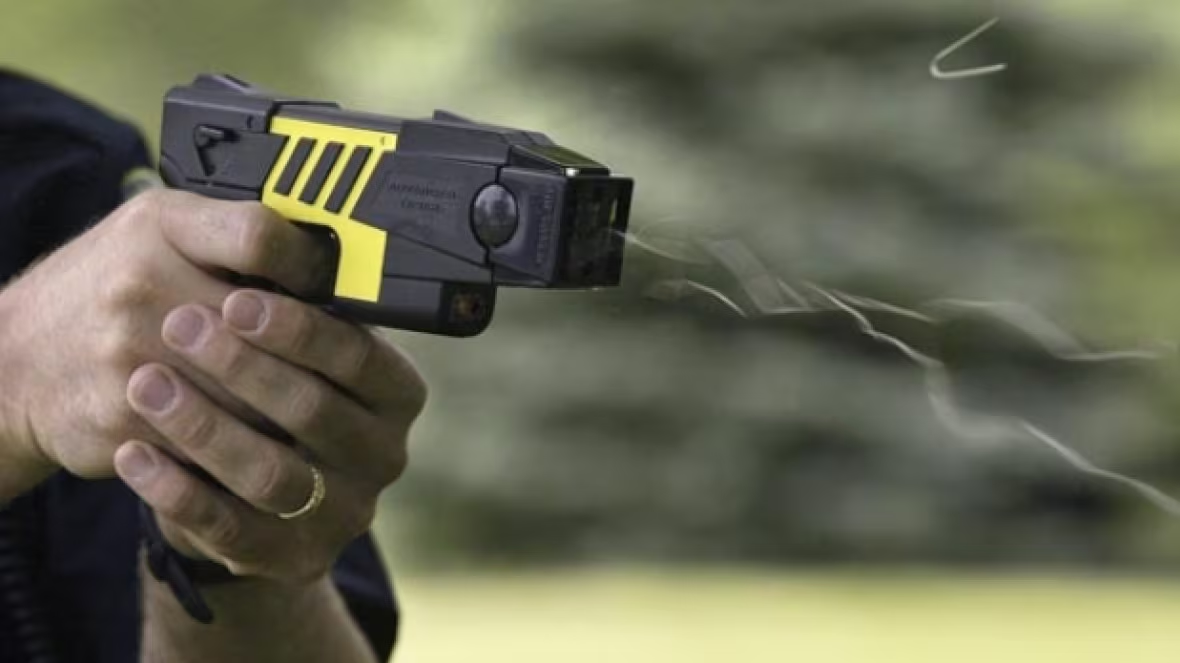
Attorney General and Minister of Legal Affairs Anil Nandlall, SC, has warned that persons who sell, purchase or possess Tasers in Guyana could face criminal charges and imprisonment.
Nandlall addressed the issue during this week’s edition of his Issues in the News programme after, he said, a journalist asked about reports that Taser devices were being sold at commercial establishments in Guyana.

“If that is ongoing in Guyana, let me say that it is absolutely unlawful and constitutes a criminal offence under the Firearms Act,” Nandlall said.
He pointed to Section 32 of the Firearms Act, which prohibits, without the authority of the minister, the manufacture, sale, transfer, purchase, acquisition or possession of certain weapons.
The provision includes “any weapon of whatever description designed or adapted for the discharge of any noxious liquid, gas or other thing.” The Act defines weapons falling under that part of Section 32 as prohibited weapons.
Nandlall said it is his legal interpretation that Tasers fall within that provision because they discharge electricity.
“I am of the considered view that Taser and Taser weapons and Taser guns fall into Category B and/or C of the prohibition stated in Section 32 of the Firearms Act,” he said.
He argued that the words “other thing” in the legislation can include electrical current, which is what a Taser emits.
To support his interpretation, Nandlall cited the English case Flack v Baldry, in which similar wording in British firearms legislation was considered in relation to an electrical stun device.
He said the English court determined that a weapon designed to cause injury through the flow of electricity could fall within the statutory prohibition where that current could reasonably be regarded as a “noxious thing.”
Nandlall argued that because Guyana’s provision uses substantially similar wording, a Guyanese court could reach a similar conclusion.
The Attorney General also relied on amendments made to Guyana’s Police Act in 2021, which expressly included “conducted electrical weapons, including a taser or stun gun” among less-lethal weapons available for law-enforcement use.
Nandlall said the fact that legislation specifically authorised police use reinforced his view that ordinary civilians do not have unrestricted authority to possess the devices.
“If the police had to get an amendment of the Police Act to use Taser guns and equipment listed here, it applies with greater force that the layman does not have the legal authority to possess such a weapon,” he said.
A person convicted summarily of contravening the provision is liable to a fine of between $50,000 and $100,000 together with imprisonment for between three and six years. On conviction on indictment, the Act provides for imprisonment of between 10 and 15 years.
Nandlall stressed that the prohibition covers more than simply carrying a Taser.
“So if you sell, you buy, you acquire, you have in your possession this prohibited weapon, then it’s an offence under the Act,” he said.