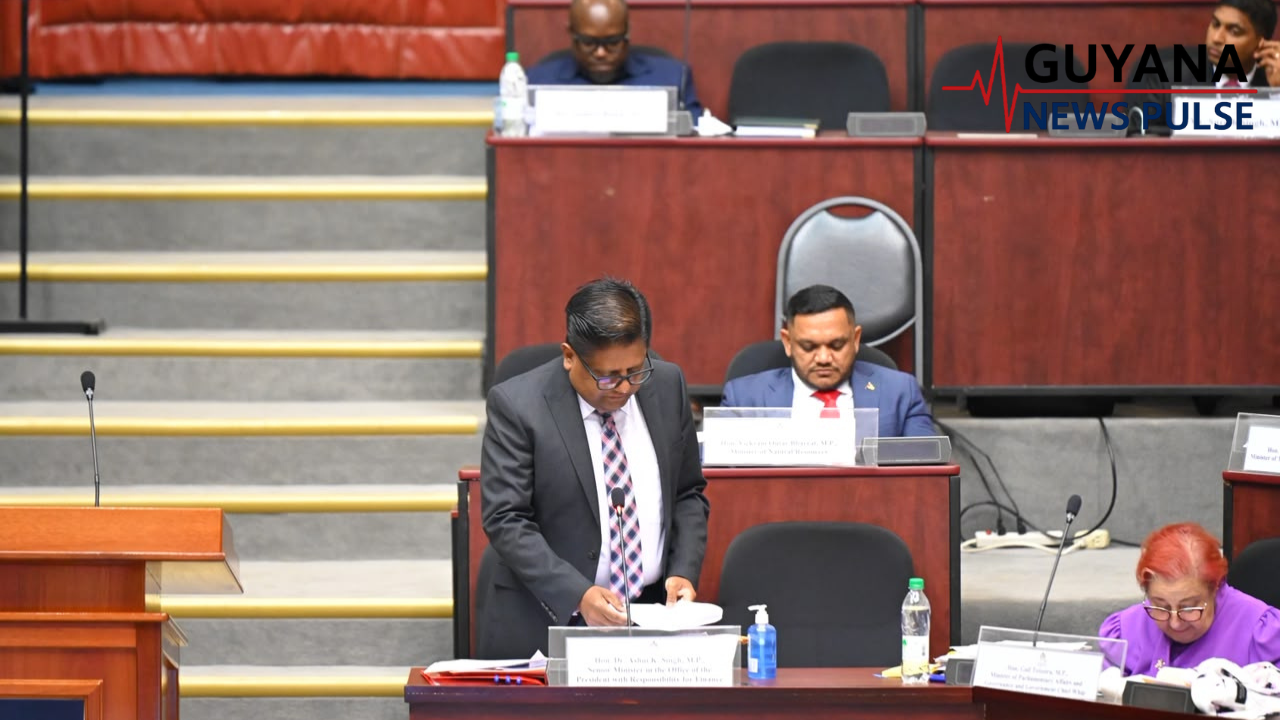
Senior Minister in the Office of the President with responsibility for Finance, Dr. Ashni Singh, has tabled a series of loan agreements in the National Assembly, including financing for safer roads and climate-resilient water infrastructure as government continues to push major development projects across the country.
According to a Ministry of Finance press release, the agreements reflect what the government described as a prudent and disciplined approach to public borrowing, with financing tied to high-impact investments and structured on favourable terms.
Among the major agreements tabled is a financing package equivalent to US$156 million from the International Development Association, part of the World Bank Group, for Guyana’s Integrated Transport Corridors Project. The agreement was signed on October 14, 2025.
The project is expected to support safer and more climate-resilient road infrastructure, including the rehabilitation and upgrading of key corridors, drainage improvements, slope stabilisation, crash barriers and traffic-calming measures. It will also strengthen institutional capacity in road sector management through road safety diagnostics, mobility assessments and community mobility plans, with special emphasis on women’s needs and climate resilience.
The release noted that the World Bank agreement includes a Climate Resilient Debt Clause, which allows for payment deferrals during declared national emergencies, as well as a Rapid Response Option for swift access to funds in times of crisis.
Also tabled were two agreements signed with the Inter-American Development Bank on November 14, 2025, aimed at strengthening water and sanitation services. These include a US$30 million Conditional Credit Line for Investment Projects (CCLIP) for water and sanitation improvement in Guyana, along with a US$15.57 million first loan under that facility.
The water infrastructure programme is designed around three main components. These include the construction of new climate-resilient water infrastructure to expand potable water supply for the rapidly growing Diamond area in Region Four, including a new treatment plant, surface water intake, conveyance systems, transmission mains and a solar photovoltaic plant.
The project also aims to reduce non-revenue water across East Bank Demerara, East Coast Demerara and Cummings Lodge through 40,000 ultrasonic smart meters, leak and pressure management, and public conservation campaigns. A third component will focus on strengthening Guyana Water Incorporated’s commercial, operational and financial management, including digital transformation and cybersecurity measures.
In addition to those new agreements, amendments to three existing financing arrangements were also tabled. These involve the Export-Import Bank of the United States facility financing the Gas-to-Energy Project, an IDB loan supporting the Strengthening Energy Matrix Diversification Programme, and the CARICOM Development Fund Agreement financing the Agricultural and Infrastructural Development Programme.
The Ministry of Finance said Guyana’s public and publicly guaranteed debt has fallen dramatically over the past three decades, dropping from more than 600 per cent of GDP in 1991 to 28.6 per cent at the end of 2025. It also said the debt-service burden has declined from 90 per cent of government revenues to 5.5 per cent, freeing up resources for investment in infrastructure, health, education and other national priorities.
The release added that the International Monetary Fund, in its 2025 Article IV Report, assessed Guyana as being at low risk of debt distress and having low vulnerability to large shocks, which government says reflects its commitment to fiscal discipline and prudent debt management.